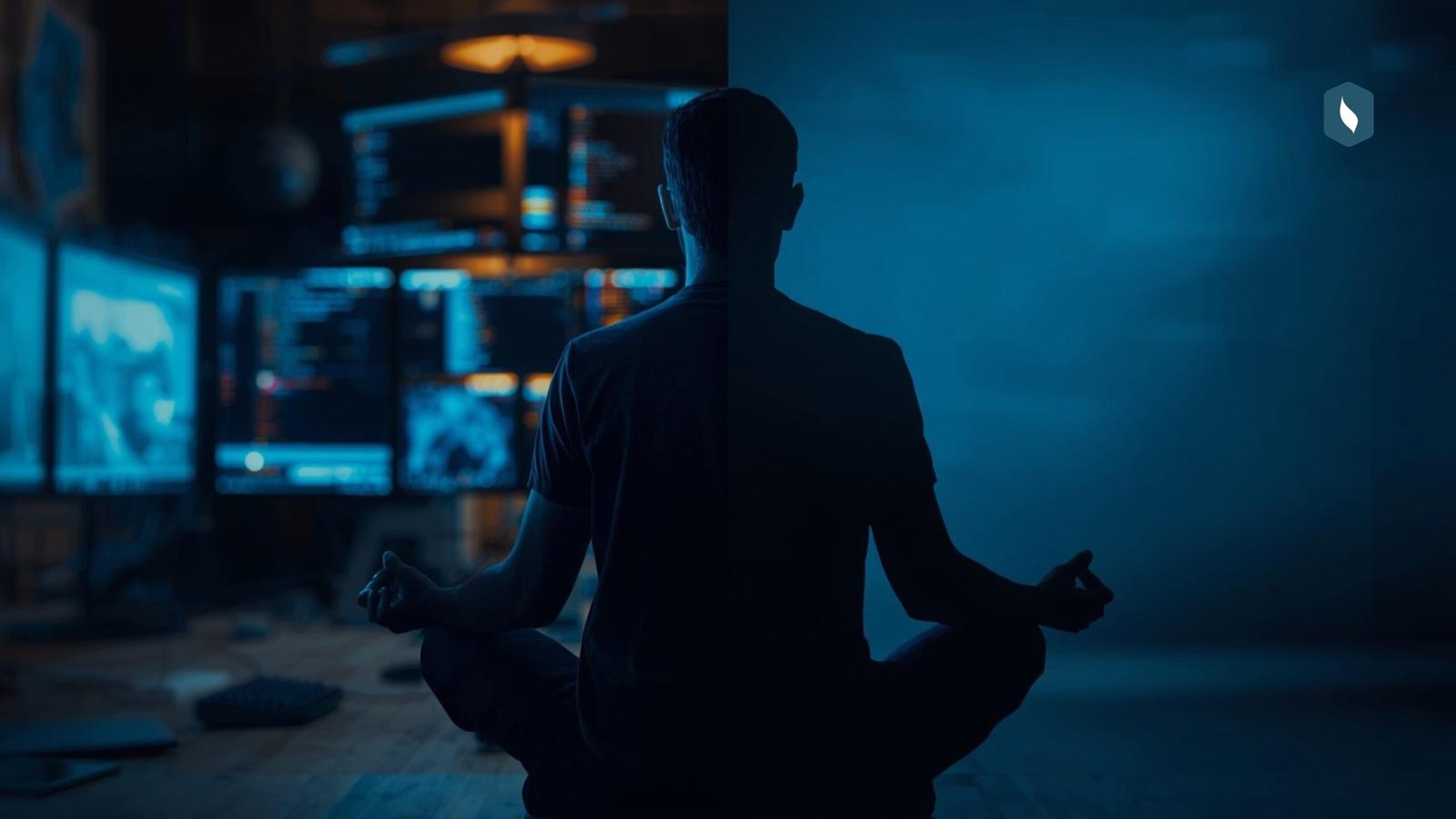


Understanding why the body resists stillness, how stress response patterns affect daily life, and how breath-based vagus nerve regulation restores balance.
What is Internal Urgency?
Internal urgency is a nervous system state where the body remains in constant readiness, even when there is no immediate demand or threat.
It often feels like:
- needing to do something even during rest
- difficulty sitting still without stimulation
- mental pressure without clear cause
- inability to fully switch off after work
This pattern is increasingly common in high-performance professionals and workplace environments where attention is continuously divided.
Have you ever noticed that even when you finally get time to pause, you still don’t feel relaxed?
You sit down after work, but your mind continues running—planning, analysing, remembering, anticipating.
This is not just a habit of overthinking.
It is often a reflection of nervous system stress and internal urgency that has become the body’s default operating state.
In modern life—and increasingly in workplaces—this shows up as difficulty switching off, constant mental activity, and a sense of being “on” even during rest.
Understanding this pattern requires looking beyond time management and into how the nervous system regulates stress.
The Hidden Habit of Internal Urgency
Most of us move through our days in a constant state of doing.
One meeting ends and another begins. A message arrives and demands attention. A task is completed, only to be replaced by three more.
Over time, this creates what we can call internal urgency—the feeling that something always needs your attention, action, or response.
Even when there is no immediate pressure, the nervous system continues operating as though there is.
This is why many people experience:
- Difficulty switching off after work
- Constant mental chatter
- Feeling tired but unable to rest
- Increased impatience and irritability
- Difficulty being present
- Stress that seems to have no obvious cause
What often appears to be a time-management problem is actually a nervous system problem.
Why Workplace Stress Feels Constant Even After Work
One of the most overlooked aspects of modern stress is that it does not end when the workday ends.
Even after leaving the workplace, the nervous system often remains in an activated state due to:
- digital notifications
- unfinished cognitive tasks
- constant decision-making
- internal pressure to stay responsive
This creates a condition where employees feel mentally “on” throughout the day and unable to fully recover afterward.
Over time, this affects:
- focus and decision-making
- emotional regulation
- sleep quality and recovery
- long-term productivity and wellbeing
This is not just stress caused by workload.
It is a nervous system regulation issue.
Why Relaxation Can Feel Uncomfortable
Many people begin meditation expecting relaxation and calm.
Instead, they encounter restlessness.
The mind wanders. The body fidgets. Thoughts become louder. There is an urge to move, adjust, analyse, or “do it properly.”
This can feel frustrating, but it is completely normal.
Stillness does not create restlessness.
It reveals it.
The moment we stop distracting ourselves, we become aware of the speed at which we have been operating.
For some people, slowing down feels unfamiliar because they have spent years functioning in a state of constant activation.
Meditation Is Not Another Task
One of the most common misconceptions about meditation is that it is something we need to perform well.
People often ask:
- Am I doing this correctly?
- Why can’t I stop thinking?
- Should I be feeling calmer?
- Why is this difficult?
These questions come from what we might call doing mode.
Meditation invites us into experiencing mode.
Instead of trying to create a particular experience, we learn to notice what is already happening.
The breath.
The body.
The thoughts.
The sensations.
The goal is not to achieve a perfect state.
The goal is awareness.
There is nothing to perform.
There is only something to experience.
The Role of the Vagus Nerve
When we talk about slowing down, we are referring to physiological regulation.
A key part of this process is the Vagus Nerve, which plays a central role in activating the body’s parasympathetic nervous system—the system responsible for rest, recovery, and emotional regulation.
When stress becomes chronic, the nervous system remains in a heightened state of activation:
- breathing becomes shallow
- muscles stay tense
- attention becomes narrow
- emotional flexibility reduces
This state is functional in short bursts, but problematic when sustained over time.
In workplace contexts, this often presents as burnout, fatigue, irritability, and reduced cognitive clarity.
The Breath: Your Built-In Reset Tool
TThe good news is that we carry one of the most effective nervous system regulation tools with us at all times.
Our breath.
Unlike most bodily functions, breathing is both automatic and conscious, which means it can be used to intentionally influence physiological and emotional states.
One of the simplest ways to support Vagus Nerve activation is by extending the exhalation.
A longer, slower exhale sends a clear signal to the body that it is safe to soften, release unnecessary muscular tension, and shift out of constant readiness.
This is why simple breath-based practices are widely used in stress management and workplace wellbeing programs, including:
- Inhaling for 4 counts and exhaling for 6 counts
- Gentle humming
- Chanting AUM
- Brief pauses of breath awareness between tasks or conversations
Despite their simplicity, these practices directly influence the body’s stress response system.
They help shift the nervous system from a state of activation into a state of regulation.
In physiological terms, this supports a return toward parasympathetic balance, improving emotional steadiness, focus, and recovery capacity over time.
These are not techniques for temporary relaxation.
They are practical tools for nervous system regulation, stress recovery, and sustained mental clarity.
Small Pauses Create Big Changes
Many people believe that wellbeing requires major lifestyle changes.
In reality, meaningful change often begins with small moments of awareness.
A conscious breath before responding to an email.
A pause between meetings.
Noticing tension in your shoulders and releasing it.
Taking a few slow breaths before an important conversation.
These moments interrupt the cycle of internal urgency and create space between what happens and how we respond.
Over time, that space becomes one of the most valuable skills we can develop.
Why This Matters at Work
Today’s workplace demands constant attention, rapid decision-making, and continuous adaptation.
While organisations invest heavily in productivity and performance, sustainable performance depends on something more fundamental: a regulated nervous system.
Employees who can recognise stress, manage their energy, regulate their responses, and recover effectively are better equipped to navigate challenges, communicate clearly, and maintain long-term wellbeing.
This is why meditation, breathwork, nervous system regulation, and mindfulness practices are increasingly becoming part of workplace wellbeing initiatives, leadership development programs, and long-term employee wellness strategies.
A Different Way Forward
At Idhya, we work with individuals and organisations to build practical skills for nervous system regulation, breath awareness, and stress recovery.
Our programs include:
- workplace wellbeing workshops
- leadership regulation training
- breathwork and meditation sessions
- long-term corporate wellbeing partnerships
The focus is not motivation or performance pressure.
It is sustainable performance through physiological regulation, emotional resilience, and mental clarity.
Because when the nervous system is regulated, people think more clearly, respond more effectively, and recover more efficiently.
Frequently Asked Questions
Why does slowing down feel uncomfortable?
Because the nervous system becomes accustomed to constant stimulation and takes time to adjust to states of stillness and reduced input.
Can breathwork reduce stress quickly?
Yes. Slow breathing patterns, especially longer exhalations, help activate the parasympathetic nervous system through vagal pathways.
What is internal urgency?
It is a persistent sense that something needs attention or action, even when there is no immediate external demand.
Can this help workplace burnout?
Yes. Nervous system regulation is increasingly used in workplace wellbeing programs to support focus, resilience, and recovery.
Try This Today
Before your next meeting, phone call, or important conversation:
- Inhale gently for 4 counts
- Exhale slowly for 6 counts
- Repeat 5 times
Then ask yourself:
Do I feel physically, mentally, or emotionally different?
That awareness is where change begins.