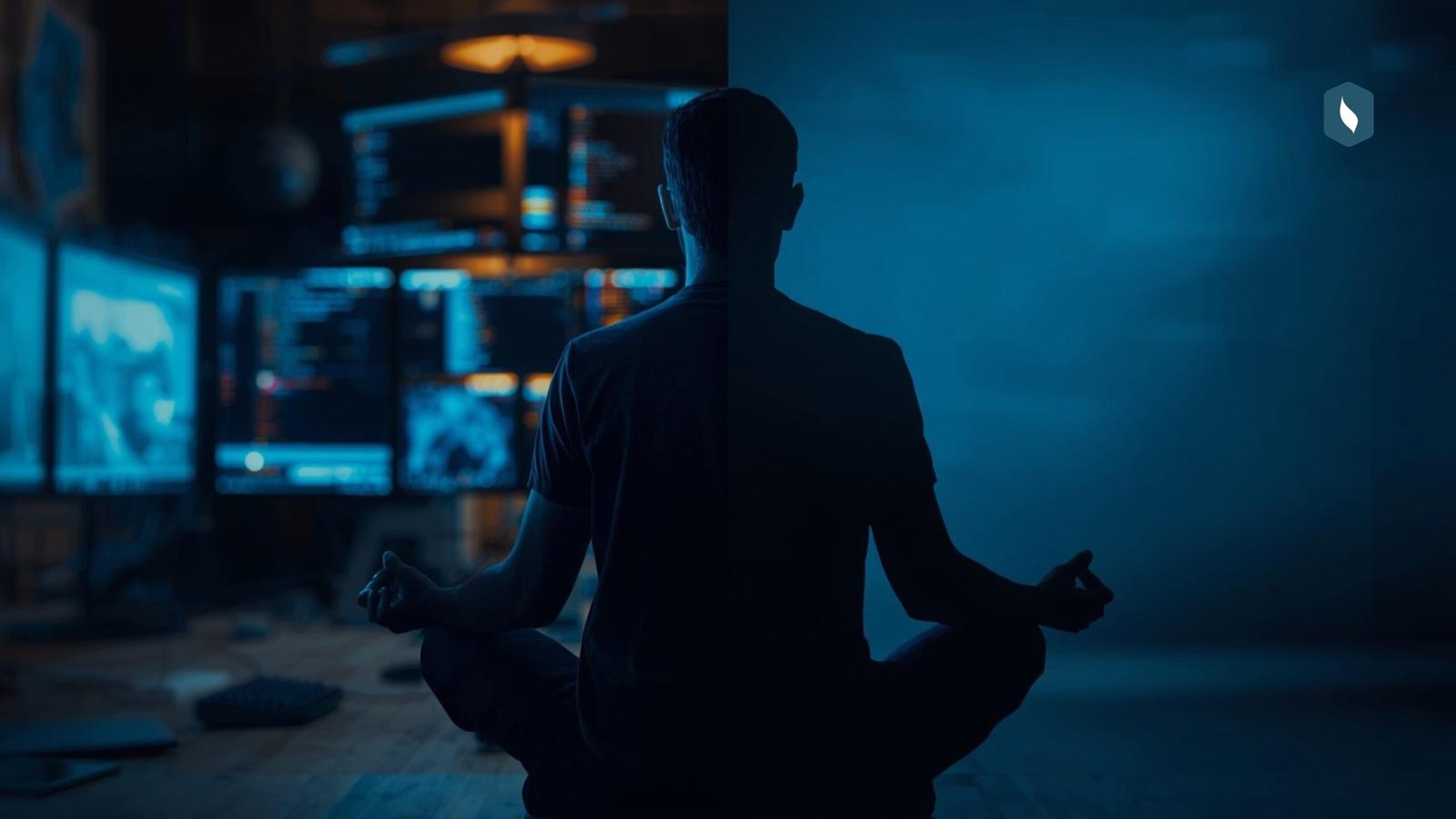


Why High Performers Struggle to Switch Off
Most high performers don’t struggle with discipline.
They struggle with switching off.
You can execute, lead, solve problems, and deliver under pressure. But when the day ends and it is time to rest, your body refuses to cooperate.
You lie down, but your mind continues scanning. Thoughts race. Sleep becomes shallow.
This is not a mindset failure.
It is a nervous system pattern.
The Nervous System Learns What We Train It To Do
High achievement trains the nervous system into constant readiness.
Every deadline, decision, and responsibility reinforces activation.
The sympathetic nervous system—the body’s alert and action state—remains engaged long after work ends.
Over time the body learns one instruction:
Stay ready.
Even when nothing is required.
Research across workplaces in India reflects the consequences of this constant activation. A survey reported that 58% of employees in India experience burnout, significantly higher than the global average. Boston Consulting Group found that prolonged stress and workplace pressure are major contributors to reduced engagement and exhaustion.
Similarly, research examining professional stress patterns shows that over one-third of professionals report high stress levels, with work demands cited as the primary cause.
The issue is not effort.
It is recovery.
Why Rest Feels Difficult for High Achievers
When the nervous system is conditioned for activation, stillness feels unfamiliar.
You may notice:
• difficulty relaxing even when tired
• checking emails or messages late at night
• racing thoughts when trying to sleep
• waking up mentally alert but physically exhausted
Your body has learned to perform, but it has not learned how to downshift.
Recovery requires retraining the nervous system to recognise safety.
A Simple Technique to Begin: Orienting the Nervous System
One of the simplest ways to shift from alertness to regulation is sensory orientation.
Pause where you are sitting.
Slowly look around the room.
Notice five things you can see.
Then notice three sounds around you.
Finally, feel your feet touching the ground.
This practice signals safety to the brain and reduces sympathetic activation. Within moments, the body begins transitioning toward recovery.
Unlike performance states, recovery must be practiced deliberately.
Training the Nervous System to Rest
Rest is not weakness.
It is a skill.
Practices such as breathwork, chanting, restorative yoga, sound-based relaxation, and Yoga Nidra help train the nervous system to move from constant activation into recovery states.
At Idhya, we have observed that many professionals struggle with this transition. Based on both research and experience working with high-pressure professionals, Saturdays are intentionally designed as spaces for nervous system reset.
Morning sessions begin with guided breath and chanting online, followed by restorative yoga, and conclude in the evening with immersive sound baths—creating structured opportunities to practice switching off.
Because the nervous system does not learn recovery by accident.
It learns through repetition.
References
Boston Consulting Group (2024). Workplace burnout survey.
Loop Health Workforce Stress Index (2023). Professional stress patterns in India.
McKinsey Health Institute. Global workplace wellbeing insights.